 In the last instalment of Commuter Etiquette: The ATM Rule, I wrote about the atraso de vida or the delay of life that plagues our morning commuter routine.
Today I’m going to tell you about a related phenomenon…I like to refer to it as The Human Speed Bump or the HSB.
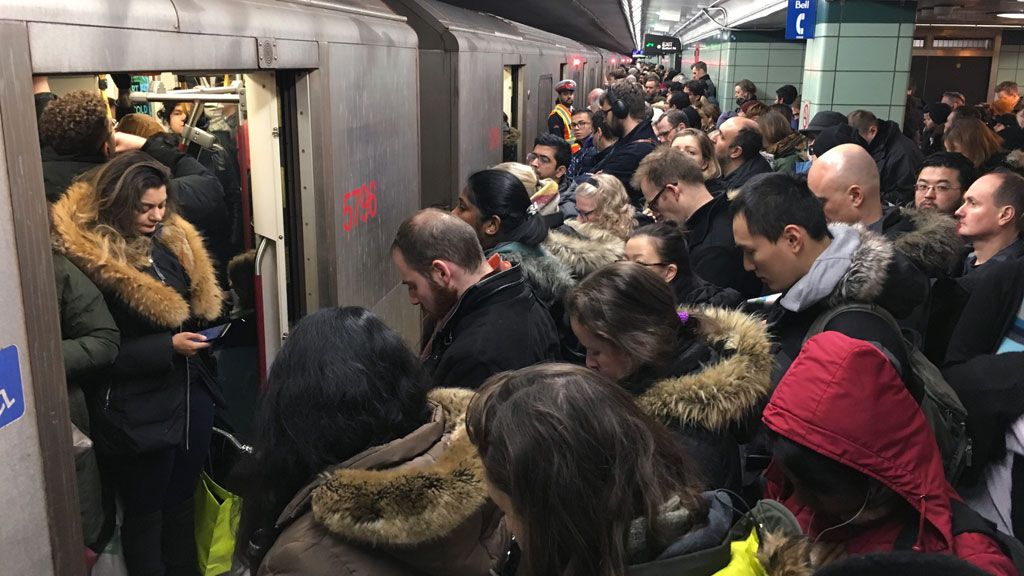
As I’ve stated before, during rush hour, tens of thousands of commuters converge on Toronto’s Union Station. They come from above ground, below ground, from every direction, all bottle-necking into one wide corridor designed to filter human traffic into the appropriate stairwell leading up to a specific train platform.
A birds-eye-view of the entire scene might resemble that of the flow of blood through a human heart; in through one ventricle, out another to be dispersed throughout the body. The city is truly a living, breathing entity and Union Station, one of its most essential organs.
Now obviously, for all of this activity to go on without a hitch, a lot of study and planning is required. Experts try to predict any and all possible impedances that may result in the slowdown of pedestrian traffic.
This is all well and good, but I just can’t help but think that there is an obstacle that the experts haven’t considered…the HSB.
Picture, if you will a sea of humanity, flowing in one direction at an urgent, yet controlled pace. Every single person with one goal in mind; to make their next train and maybe even get a seat so they don’t have to stand most of the trip.
Now the experts know that if one of those people decide to stop (for whatever reason); or change direction; or, heaven forbid, turn and walk back through the crowd like a salmon swimming upstream, a chain reaction will be set in motion.
Whomever is behind that person is forced to brake and avoid this HSB causing the next person behind them to do the same, and so on, and so forth. This can cause quite the disruption to the flow of traffic and, depending on the time of day, this disruption can be felt well outside Union Station.
Now, I may be exaggerating slightly, but only slightly. There is nothing more unnerving than when your forced to follow closely behind someone in a hurry, and they inexplicably stop, causing you to either; a) bump into them; b) trip over them; or c) swerve to avoid them. In any one of those cases, another side-effect of the HSB is that, effectively, you become one too. So, suffice it to say, HSB is a contagious condition.
The HSB Rule: Get out of the way before you do anything else.
So how can you avoid becoming HSB positive?
While in this scenario, it is important to refrain from making any sudden and acute adjustments to your course, such as stopping, reversing, or turning hard left or right. Instead, when faced with an instance where you’re forced to do so, such as an untied shoelace (the human equivalent to a blown-out tire), or a call to nature, or the need to look at the departure board to see when your next train is due; you should resist the temptation to stop on the spot or turn hard into the person beside you. You should slightly adjust your course into a trajectory that will lead you toward the outer edge of the stream of people before attempting to exit the lane of traffic. This will cause the least amount of disruption to those moving around you.
It is also imperative that you mind your cargo. In an aggressive manoeuvre to exit the stream, any carry-on bags or luggage in tow, can become a dangerous obstacle, especially if said luggage tips in the process of a turn. This is a common cause of trips and people pile-ups.
Other Rules:
Leave a Reply to Commuter Etiquette: The Escalator RuleCancel reply